
Roland Coatings follows a structured, application-driven process for developing and delivering coating solutions. The focus is on clear requirements, controlled formulation work, and consistent production support for customers who rely on dependable coating performance in regulated and high-demand environments, including food packaging and industrial applications.
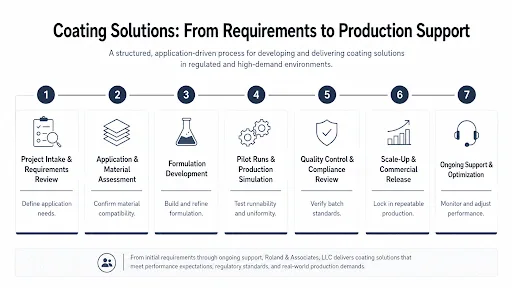
Project Intake and Requirements Review
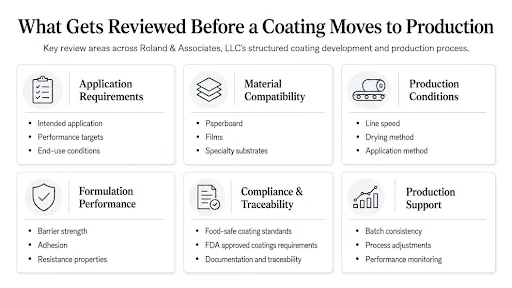
Each project begins with a detailed review of the intended application. This includes substrate type, production method, performance targets, and end-use conditions such as moisture exposure, grease resistance, or heat handling. Regulatory requirements are identified early, especially where food-safe coating standards apply. When applicable, the need for FDA compliant coatings is also reviewed as part of the compliance scope. This step defines the working parameters before any development begins.
Application and Material Assessment
The next step focuses on how the coating will interact with the customer’s material system. Paperboard, fiber, or specialty substrates are reviewed for compatibility with coating chemistry and production equipment. Line conditions such as speed, drying method, and application method are also considered. This stage confirms whether adjustments are needed to align performance expectations with real production conditions.
Formulation Development
Coating development is conducted in a controlled lab environment. Formulations are built based on required performance characteristics such as barrier strength, adhesion, and resistance properties. Multiple iterations may be produced to refine performance and processing behavior. Where required, formulation work supports FDA compliant coatings requirements, especially for packaging applications involving direct or indirect food contact. The goal is a stable coating system that performs consistently under production conditions.
Pilot Runs and Production Simulation
Once a formulation is approved internally, pilot-scale testing begins. This step replicates production line conditions as closely as possible. Coatings are applied using actual or simulated equipment to evaluate runnability, drying behavior, and coating uniformity. Feedback from these runs is used to adjust viscosity, application rates, or cure conditions until performance aligns with production expectations.
Quality Control and Compliance Review
Every production batch is reviewed against defined quality parameters. Testing includes coating consistency, performance verification, and application behavior checks. For projects involving FDA compliant coatings, documentation and traceability are maintained to support regulatory alignment. This step confirms that each batch matches approved standards before release.
Scale-Up and Commercial Release
After successful validation, the coating system moves into full production scale. This phase focuses on stable output, repeatable performance, and alignment with customer manufacturing schedules. Process settings are locked in to maintain consistency across production runs, supporting long-term supply reliability.
Ongoing Support and Optimization
After commercial release, technical support continues as needed. This includes process adjustments, performance monitoring, and production feedback review. If production requirements shift or material systems change, updates are made to maintain coating performance. Support remains focused on practical production outcomes and consistent material performance in food-safe coating applications.
Ready When Your Coating Process Needs to Perform?
No guesswork. No trial-and-error loops. Just coatings that move from idea to production with purpose. If you’re working on a project that calls for food-safe coating systems, regulated performance standards, or toll processing for food grade coatings, we’re set up to step in where precision matters most. Talk with Roland Coatings today and get your process moving.